Myrtle Beach Real Estate Market Update | November 2026
November 10, 2026
November 10, 2026
A homeowner in Market Common sees a nearby house go under contract. Meanwhile, an oceanfront condo owner watches comparable units reduce their asking prices. Both are watching the Myrtle Beach real estate market, but they're seeing very different things.
That's what makes the current housing market so interesting.
Mortgage rates have been moving, buyers are paying closer attention to ownership costs, and some property categories are experiencing more price pressure than others.
The latest numbers reveal a market that requires a little more interpretation than a headline about prices going up or down.
And if you're considering selling your home in Myrtle Beach, understanding those differences may be more valuable than knowing the regional median price.
According to the Coastal Carolinas Association of REALTORS®, the broader Grand Strand market recorded 1,380 closed sales during October 2026, compared with 1,466 during October 2025.
The median sales price increased from $365,000 to $370,000.
Available inventory decreased slightly, from 7,229 properties to 7,090.
Grand Strand market indicator | October 2025 | October 2026 |
|---|---|---|
Closed sales | 1,466 | 1,380 |
Median sales price | $365,000 | $370,000 |
Available inventory | 7,229 | 7,090 |
Total monthly sales volume | $617 million | $594 million |
Source: Coastal Carolinas Association of REALTORS®, October 2026 regional market statistics.
At first glance, prices appear relatively stable even as fewer properties sell.
But regional statistics include many property types and communities. They don't explain what is happening within every neighborhood or price range.
For a more useful comparison, let's look at single-family homes and condominiums separately.
One of the more revealing trends appears in the Myrtle Beach-specific September 2026 housing report.
For this dataset, Myrtle Beach refers to ZIP codes 29572 and 29577.
In September, single-family inventory increased 17.1% compared with September 2025. Yet year-to-date closed sales were up 5%.
The year-to-date median single-family sales price declined just 1.4%.
Condominiums and townhouses told a different story.
Their year-to-date median sales price declined 10.9%, from $230,000 to $205,000.
Myrtle Beach market segment | Jan.–Sept. 2025 median | Jan.–Sept. 2026 median | Change |
|---|---|---|---|
Single-family homes | $530,000 | $522,500 | -1.4% |
Condos and townhouses | $230,000 | $205,000 | -10.9% |
Source: Coastal Carolinas Association of REALTORS® September 2026 Local Market Update, ZIP codes 29572 and 29577.
These figures are not proof that every condo lost value or that every single-family home maintained its price.
The mix of properties sold can influence median prices.
Still, the difference between these categories is meaningful enough that homeowners should pay attention.
Someone selling a detached home in an established neighborhood may face a very different competitive environment from someone selling a condominium along Ocean Boulevard.
That's why I prefer property-specific comparisons over broad market generalizations.
As of November 5, 2026, Freddie Mac reported a national average 30-year fixed mortgage rate of 7.18%, down from 7.24% the previous week.
That doesn't mean every buyer will receive a 7.18% rate. Individual mortgage terms depend on credit, financing, down payment, occupancy, and other qualifications.
But the rate environment affects how buyers think about affordability.
Consider a $350,000 mortgage with a 30-year fixed term.
At 6%, the monthly principal and interest payment is approximately $2,098.
At 7.18%, it's approximately $2,371.
That's about $273 more per month before property taxes, homeowners insurance, or HOA fees.
For a buyer relocating to Myrtle Beach, that difference may affect which price range feels comfortable.
For a seller, it can influence how buyers respond to the asking price.
A property that made financial sense to someone at one mortgage rate may feel less affordable when financing changes.
You can follow the latest national mortgage rate averages through Freddie Mac's Primary Mortgage Market Survey.
The condominium market deserves special attention because the asking price is only part of what buyers evaluate.
Along the Grand Strand, condo ownership may involve monthly association dues, building insurance, potential special assessments, maintenance obligations, and rental restrictions.
For investment properties, management costs and rental performance can add another layer.
Consider two condos offered at similar prices.
One has an HOA fee of $450 per month. Another has an HOA fee of $850 per month.
That's a $400 monthly difference, or $4,800 annually.
The higher-fee association may cover expenses that the other doesn't, so comparing dues alone isn't enough. Buyers need to understand what each association includes.
But when buyers are working within a monthly budget, that difference matters.
They also want to know whether an association has adequately funded reserves, whether major building projects are anticipated, and whether additional assessments may be necessary.
This is particularly relevant for older coastal buildings where roofing, balconies, elevators, exterior maintenance, and insurance can represent substantial expenses.
A condo may be competitively priced compared with recent sales but still face challenges if its total monthly ownership cost is less attractive than comparable alternatives.
The September 2026 regional report showed approximately 7.5 months of condo inventory across the broader market, compared with 4.2 months for single-family homes.
Those figures help explain why the two property categories may experience different pricing and negotiating conditions.
The Grand Strand's luxury market extends well beyond oceanfront property.
Buyers may be considering waterfront homes in Grande Dunes, established properties along the Golden Mile, Intracoastal Waterway communities, or coastal estates in Pawleys Island and DeBordieu.
These properties often appeal to buyers with different financing circumstances, relocation needs, and lifestyle priorities.
Some purchasers may bring significant equity from a previous home. Others may purchase with cash or use financing differently from buyers in more conventional price ranges.
That doesn't make luxury real estate immune to market conditions.
A higher-priced property still needs to be evaluated against its competition, location, condition, and buyer audience.
But the characteristics influencing a luxury waterfront purchase can be quite different from those driving demand for a $350,000 primary residence.
Even within the luxury category, waterfront access, dock permits, view corridors, lot dimensions, and the location of neighboring properties can meaningfully affect value.
A regional median sales price won't capture those differences.
When I'm representing a seller, the market begins giving us feedback almost immediately.
We can see whether people are viewing the listing, requesting information, scheduling showings, and comparing the property with competing homes.
That activity helps us evaluate the property's positioning.
A listing can attract substantial online attention without generating appointments.
Another property may receive fewer online views but attract serious buyers who are already prepared to make a purchase.
Neither metric should be considered in isolation.
I also want to know what happens when similar properties enter the market.
Did a competing home offer a lower asking price? Does it have a better lot? Is it newer? Does it include improvements that buyers would otherwise have to purchase?
And when competing properties go under contract, what can we learn from how they were positioned?
These are the questions I find most useful when evaluating how a home is performing.
I spent years working in photography and creative direction before focusing on real estate, and that experience has shaped how I approach property marketing.
A home's first showing often happens on a screen.
Buyers may be comparing multiple listings from another state, trying to understand floor plans, neighborhood locations, and which properties are worth visiting in person.
Photography needs to communicate more than whether a room is attractive.
It should help buyers understand how the home lives.
Natural light, architectural details, outdoor spaces, views, and the relationship between rooms all influence that first impression.
For a home in Market Common, the neighborhood lifestyle may be an important part of the story.
For a Murrells Inlet property, outdoor living or proximity to the water may be particularly relevant.
And for an oceanfront residence, the view and property's relationship to the beach deserve careful attention.
The presentation should reflect what makes that particular home worth considering.
But even exceptional photography can't compensate for an asking price that the market doesn't support.
The marketing and pricing strategy need to work together.
This is an increasingly important comparison in parts of Carolina Forest, Conway, and other communities with active building.
A resale homeowner may be competing against a builder offering closing cost assistance, mortgage rate incentives, or discounted inventory.
Those offers can influence buyers who are comparing monthly payments and available cash.
On the other hand, resale homes may include substantial improvements that aren't standard with new construction.
A fence, mature landscaping, screened porch, irrigation, gutters, and upgraded storage all have value to the right buyer.
A new home with an appealing advertised starting price may cost considerably more after adding a lot premium and desired features.
That's why it's worth examining what a buyer is actually receiving rather than comparing listing prices without context.
For sellers, knowing what builders are offering nearby can help shape how an existing home is marketed.
If you asked me what your Myrtle Beach home might sell for today, I wouldn't begin with the regional median.
I'd look at recent closed sales involving properties with similar characteristics.
Then I'd compare the listings currently available to the buyers most likely to consider your home.
I'd also review pending transactions where useful information is available, recent price reductions, and how long comparable homes have been marketed.
Beyond the numbers, I'd consider the property's condition and features that may distinguish it.
A desirable lot, conservation view, larger garage, or thoughtfully designed outdoor living area may influence the comparison.
So can an older roof, deferred maintenance, unfavorable lot placement, or significant recurring ownership expenses.
The objective is to establish a price supported by relevant evidence and a marketing plan that helps buyers recognize the property's value.
That depends on much more than the latest mortgage rate or monthly market report.
Some homeowners have flexibility. Others are coordinating a relocation, purchasing another property, managing two mortgages, or preparing for a major life change.
Waiting may allow more time to prepare a home, but it also means continuing to carry its expenses.
Selling sooner may serve a homeowner's personal timeline, provided the pricing and market expectations are realistic.
Before making that decision, it's worth considering your likely net proceeds, competing listings, current buyer activity, and what you plan to do after the sale.
A home that's already paid off creates a different financial conversation from one with a substantial mortgage balance.
Likewise, someone selling a vacation condo may evaluate the decision differently from a family moving out of their primary residence.
The market matters, but your circumstances matter too.
Are Myrtle Beach home prices dropping in November 2026?
The answer depends on the property type and location. The broader Grand Strand median sales price was $370,000 in October 2026, up approximately 1.4% year over year. However, Myrtle Beach-specific September data showed a 10.9% decline in the year-to-date median price for condos and townhouses, while single-family homes experienced a smaller 1.4% decline. These figures represent different geographic areas and reporting periods.
Are condos harder to sell than single-family homes in Myrtle Beach?
Some condo market indicators suggest more competition. The broader regional September report showed approximately 7.5 months of condo inventory compared with 4.2 months for single-family homes. Individual building conditions, views, HOA expenses, and asking prices can produce very different outcomes.
Are luxury homes still selling along the Grand Strand?
Yes, luxury transactions continue to occur, although the level of demand varies by location, price range, and property characteristics. A waterfront estate should be evaluated against relevant luxury comparables rather than the overall regional median.
How do mortgage rates affect sellers?
Higher mortgage rates can increase buyers' monthly financing costs and influence purchasing power. Sellers may need to evaluate how their asking price and property features compare with alternatives available to buyers at similar monthly ownership costs.
How do I know whether my home is priced correctly?
Review recent comparable sales, active competition, relevant pending activity, days on market, and the feedback generated by your listing. A property-specific comparative market analysis is more useful than relying solely on an automated valuation or broad market headline.
Should I reduce my asking price if my home isn't getting showings?
Not automatically, but the lack of activity deserves investigation. Compare your listing with competing homes, evaluate the photography and online presentation, confirm showing availability, and review whether the asking price aligns with current buyer expectations.
Is now a good time to buy a home in Myrtle Beach?
It depends on your financing, budget, preferred neighborhoods, and intended use. Some segments may offer additional inventory and negotiating opportunities. Desirable properties with limited direct competition may still attract strong interest.
What if I'm considering selling but haven't committed to moving?
That's a good time to understand your home's potential market value and current competition. You can research likely proceeds, selling expenses, and available alternatives before deciding whether a move makes financial and practical sense.
The latest statistics show meaningful differences between property categories, neighborhoods, and buyer budgets.
Some homes continue to attract serious interest. Others face stronger competition or ownership-cost concerns that deserve attention before listing.
If you're thinking about selling, I'd begin by understanding what your home is worth in today's market, which properties buyers are comparing it against, and how its strongest features should be presented.
As a second-generation Myrtle Beach Realtor with a background in photography and creative direction, I bring both market analysis and a visual marketing perspective to that process.
Whether you're considering selling in Market Common, Carolina Forest, Surfside Beach, Murrells Inlet, North Myrtle Beach, or Pawleys Island, I'm always happy to be a resource.
Explore more real estate insights and learn about working with me at Myrtle Beach Megan.
Market update dated November 7, 2026. Sources include Coastal Carolinas Association of REALTORS® October 2026 regional statistics, its September 2026 local and regional market reporting, and Freddie Mac's November 5, 2026 Primary Mortgage Market Survey. Market statistics represent different reporting areas and periods as identified. This article is informational and does not constitute financial advice.
Single-family homes are holding their ground while condos face a different set of challenges. What November's market data means for buyers and sellers along the Grand … Read more
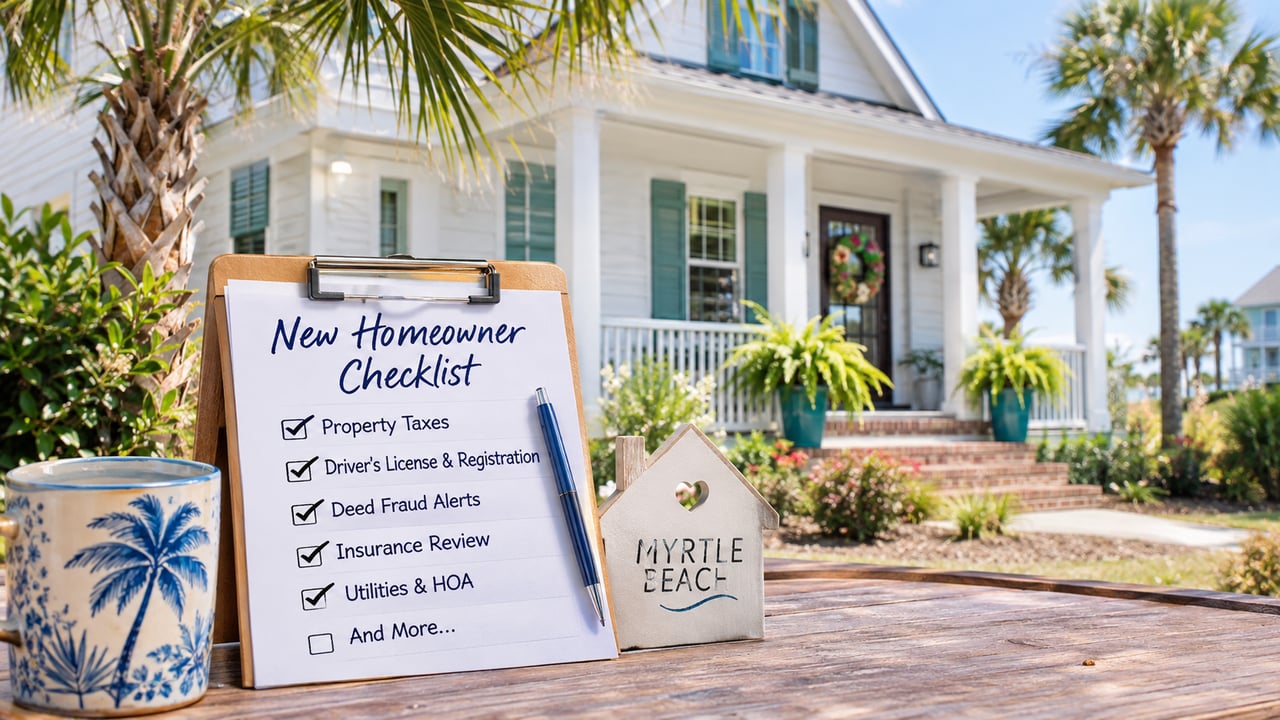
From property tax savings to paperwork most buyers overlook, here's what to take care of after getting the keys to your coastal home.
How South Carolina's 25% ATI exemption could lower property taxes on qualifying second homes and investment properties along the Grand Strand.

A new sales tax begins May 2027, with property tax credits planned for homeowners, second-home owners, and other property taxpayers across Georgetown County.

Myrtle Beach Real Estate Tips
How to protect your coastal property with free deed monitoring alerts in Horry and Georgetown Counties before a costly surprise catches you off guard.
How one simple application could save Myrtle Beach homeowners thousands in property taxes each year.



From buying and selling to real estate investing, Megan Parker delivers trusted guidance, local market expertise, and personalized solutions tailored to your goals. Her client-focused approach ensures a smooth, successful experience at every stage of your real estate journey.