Myrtle Beach Homeowners Insurance: What Buyers Should Know
November 13, 2026
November 13, 2026
You've found a home in Myrtle Beach that checks nearly every box. The location is right, the floor plan works, and the asking price fits comfortably within your budget.
Then comes the insurance quote.
It's one of the expenses buyers sometimes underestimate, especially when relocating from a state where hurricanes, wind exclusions, and coastal deductibles aren't part of an ordinary home purchase.
Two houses listed for $500,000 can carry surprisingly different insurance costs. And the more expensive property isn't necessarily the one closest to the ocean.
A home's roof, construction, location, claims history, and intended use can all influence what an insurance company is willing to cover and how much that coverage costs.
That's why Myrtle Beach homeowners insurance should be part of the conversation before you fall completely in love with a property.
When buyers begin searching for homes in Myrtle Beach, they typically have a comfortable monthly mortgage payment in mind.
That calculation usually includes principal, interest, estimated property taxes, and insurance.
But the insurance figure used in an early mortgage estimate may be just that: an estimate.
A lender might use a general insurance allowance while preparing financing numbers. Once an actual property is selected, the buyer's insurance agent can determine what coverage is available and what the premium may be.
Consider two similarly priced properties.
One is a newer home in Carolina Forest with a relatively recent roof and conventional construction.
The other is an older coastal cottage in Surfside Beach with a roof nearing the end of its expected life and a different level of wind exposure.
Their purchase prices may be similar. Their insurance profiles may be quite different.
And until you receive property-specific quotes, it's difficult to know how that difference affects the cost of ownership.
A beautiful kitchen can make a strong first impression. Insurance companies are often more interested in what's happening above it.
The roof is one of the most important parts of a home's insurance evaluation.
Depending on the insurer, the age, condition, covering material, installation, and documentation of a roof can influence underwriting and pricing.
A roof that looks perfectly acceptable from the driveway may still raise questions during the insurance process.
This is particularly relevant when considering older homes around the Golden Mile, established neighborhoods in North Myrtle Beach, or coastal properties that have experienced years of salt air and storms.
Before making a purchase decision, I like buyers to understand a few things about the roof:
A seller's statement that the roof is in good condition is helpful background, but it isn't a substitute for an inspection or an insurer's underwriting decision.
If an insurer requires repairs or replacement before issuing coverage, that can become an important part of the purchase timeline.
Along the South Carolina coast, wind coverage deserves particular attention.
Many standard homeowners policies cover wind damage. However, some coastal properties may require separate wind and hail coverage or a different insurance arrangement.
South Carolina has a specialized insurance mechanism called the South Carolina Wind and Hail Underwriting Association, commonly known as the Wind Pool.
The Wind Pool provides wind and hail insurance for eligible properties in designated coastal areas when that coverage isn't available through the standard insurance market.
It isn't automatically required for every home near the beach, and eligibility depends on the property's location and other criteria.
An insurance agent familiar with coastal South Carolina can help determine whether a traditional policy includes wind coverage or whether separate coverage needs to be considered.
You can learn more through the South Carolina Wind and Hail Underwriting Association.
One detail worth understanding is that a policy's total premium doesn't tell the entire story. Buyers should look at how much coverage they're receiving and what they'll pay out of pocket if a covered loss occurs.
This is one of the most important distinctions for buyers unfamiliar with coastal insurance.
Some homeowners insurance policies include separate hurricane, named-storm, or wind and hail deductibles calculated as a percentage of the insured dwelling value.
Let's say a home is insured for $500,000 and the policy has a 2% named-storm deductible.
That deductible would equal $10,000.
Insured dwelling amount | 2% deductible | 5% deductible |
|---|---|---|
$350,000 | $7,000 | $17,500 |
$500,000 | $10,000 | $25,000 |
$750,000 | $15,000 | $37,500 |
These are mathematical examples, not quotes or indications of which deductible a particular insurer will offer.
The deductible is generally calculated using the applicable insured value rather than simply the home's purchase price.
It's also important to understand what events trigger a separate deductible. A named-storm deductible isn't necessarily applied in the same way as an ordinary wind and hail deductible.
When reviewing quotes, ask your agent to explain the deductible in actual dollars.
That's a much more useful number to understand than a percentage alone.
A home doesn't need to be oceanfront to have flood exposure.
Properties near tidal creeks, marshes, rivers, drainage corridors, and other low-lying areas may have flood considerations that aren't obvious during a showing.
Standard homeowners insurance generally doesn't cover damage caused by flooding.
Flood coverage is typically purchased separately through the National Flood Insurance Program or a private insurer.
Lenders generally require flood insurance for certain financed properties located within designated high-risk flood zones.
But a property located outside those zones can still flood.
FEMA's flood maps are a useful starting point, although they don't describe every possible source of flooding or every property's individual risk.
You can research an address using the FEMA Flood Map Service Center.
I've also covered this subject in more detail in What Affects Flood Insurance Costs on the Coast?, including elevation certificates, construction types, and the differences between flood zones.
When comparing homes, it's worth getting both homeowners and flood insurance estimates, when applicable, rather than assuming one policy addresses everything.
Buyers sometimes ask what the current homeowner pays for insurance.
That's a reasonable question, and the answer can offer some context.
But the seller's premium isn't a guarantee of what the next owner will pay.
The seller may have different coverage limits, discounts, deductibles, or underwriting circumstances.
Their policy may also have been issued under terms that are no longer available to a new customer.
Even if the property hasn't changed, the insurance market and available rates may have.
I would treat the seller's insurance information as a reference point and obtain a new quote using the specific property address and the coverage the buyer intends to carry.
That gives you a far more useful number for budgeting.
This is especially important for people considering condominiums in Myrtle Beach, North Myrtle Beach, or along the oceanfront.
Condo associations commonly maintain master insurance policies, but those policies don't necessarily cover everything inside an individual unit.
The association's governing documents and insurance contract determine what portions of the property are covered.
An individual owner may need a separate condominium policy, often called an HO-6 policy, for certain interior improvements, personal belongings, liability, and other exposures.
It's also worth reviewing whether the association has a separate wind deductible, what the master policy covers, and whether owners could face assessments related to insured or uninsured losses.
A condominium with a substantial monthly HOA fee doesn't automatically mean all your insurance needs are included.
Before purchasing, ask for the association's current insurance information and have a qualified insurance professional review how the master policy relates to your individual coverage.
Not every property along the Grand Strand will be used as a primary residence.
Some buyers are purchasing weekend homes, seasonal retreats, or properties they plan to rent when they're away.
That distinction matters to insurance companies.
A home occupied year-round may have different underwriting and coverage requirements from one that sits vacant for extended periods.
And if a property will be used for short-term rentals, the insurance arrangements need to reflect that activity.
An ordinary homeowners policy may not provide the protection a vacation rental owner expects.
Before purchasing a rental property in Murrells Inlet, Garden City, Surfside Beach, or North Myrtle Beach, discuss the intended use with a licensed insurance agent.
Make sure the coverage is appropriate for how the property will actually be occupied.
Potentially, although savings depend on the property and insurer.
South Carolina has insurance provisions that encourage certain storm-resistant construction and mitigation improvements.
Features such as qualifying roof improvements, protected openings, storm shutters, and other approved measures may make a property eligible for insurance credits with participating insurers.
The South Carolina Department of Insurance explains that insurers must offer applicable mitigation discounts on the wind portion of premiums, although the amount can vary.
You can review additional information through the South Carolina Department of Insurance's hurricane preparedness resources.
If a home has undergone significant improvements, request documentation.
A recent roof replacement or properly documented hurricane-mitigation work could be relevant when obtaining quotes.
The important part is confirming whether the specific insurer recognizes those improvements rather than assuming an upgrade automatically guarantees a discount.
When two properties are competing for your attention, I recommend comparing the complete ownership picture rather than looking exclusively at listing prices.
Ask a licensed insurance agent to prepare quotes using consistent coverage assumptions where possible.
Then compare:
If a lender is involved, confirm the proposed coverage satisfies the lender's requirements.
You can also explore South Carolina's homeowners insurance price comparison tool for general information about insurer pricing. Keep in mind that the tool provides illustrative estimates rather than property-specific quotes.
An independent insurance agent who works regularly with coastal properties may be able to compare multiple carriers and identify potential underwriting concerns early.
How much does homeowners insurance cost in Myrtle Beach?
There isn't one dependable premium that applies to every Myrtle Beach property. Pricing depends on factors including location, insured replacement cost, construction, roof condition, coverage choices, deductibles, and insurer underwriting. A property-specific quote is the most reliable way to estimate your expense.
Should I get an insurance quote before making an offer?
Ideally, yes. If you're seriously considering a property, an early insurance estimate can help reveal affordability or coverage concerns. If a complete quote isn't available before making an offer, address insurance promptly during the applicable due diligence period.
Does living farther from the beach mean my insurance will be cheaper?
Not necessarily. Coastal exposure can influence insurance costs, but roof condition, construction, replacement value, and insurer underwriting also matter. Properties farther inland can still have wind and flood exposure.
What is the difference between a hurricane deductible and a regular deductible?
A regular deductible is often a fixed dollar amount. A hurricane or named-storm deductible may be calculated as a percentage of the insured dwelling value and triggered under specific policy conditions. The difference can mean thousands of dollars in potential out-of-pocket expenses.
Do I need flood insurance if my home is in Flood Zone X?
Flood insurance may not be required by your lender solely because the property is in Zone X, but that doesn't mean flooding is impossible. Consider the property's actual exposure and discuss coverage with your insurance agent.
Can an older roof make a house harder to insure?
It can. Insurers may consider roof age, condition, materials, and previous damage. Some may request additional inspections, impose conditions, or decline coverage based on their underwriting rules.
Does my condo HOA cover homeowners insurance?
The association's master policy may cover certain portions of the structure and common areas. Individual owners may still need an HO-6 policy and potentially other coverage. Review the association documents and master policy before relying on the HOA's insurance.
What if I'm just looking at Myrtle Beach homes and haven't made an offer?
You can still begin researching insurance costs. The South Carolina Department of Insurance offers an online comparison tool, and an insurance agent can often provide preliminary guidance based on an address or property details. This can help you narrow your search before committing to a particular home.
A beautiful home can make it easy to focus on the features you'll enjoy every day.
Maybe it's a screened porch overlooking the marsh, a walkable neighborhood in Market Common, or a beach house with room for everyone to gather.
Those things matter. So does knowing what it will cost to protect the property.
When I'm helping buyers compare homes along the Grand Strand, I want the financial picture to be as clear as possible before they reach the closing table.
That includes property taxes, HOA obligations, insurance, and the characteristics that can affect ongoing ownership expenses.
As a second-generation Myrtle Beach Realtor, I help buyers explore homes throughout Myrtle Beach, North Myrtle Beach, Surfside Beach, Murrells Inlet, Pawleys Island, and the surrounding coastal communities.
If you're beginning your search, I'd be happy to help you explore the market and connect with qualified local professionals who can evaluate insurance for the properties you're considering.
Learn more at Myrtle Beach Megan.
Information current as of November 2026. Insurance availability, rates, deductible terms, and coverage requirements vary by property and insurer. This article is provided for general information and is not insurance, legal, or financial advice. Consult a licensed insurance professional for recommendations specific to your property.
Two coastal homes can have the same price tag and very different insurance costs. Here's what buyers should know before making an offer.

Taxes, Fees and Rules
Registration, insurance, and the local rules that change from one Grand Strand town to the next, checked against the statute as amended in May 2026.

Market Reports
Through November 9, 10,322 single family homes sold, three more than last year, at an average price up 2.8% and four days faster.
Market Reports
Single-family homes are holding their ground while condos face a different set of challenges. What November's market data means for buyers and sellers along the Grand … Read more
Buying and Selling
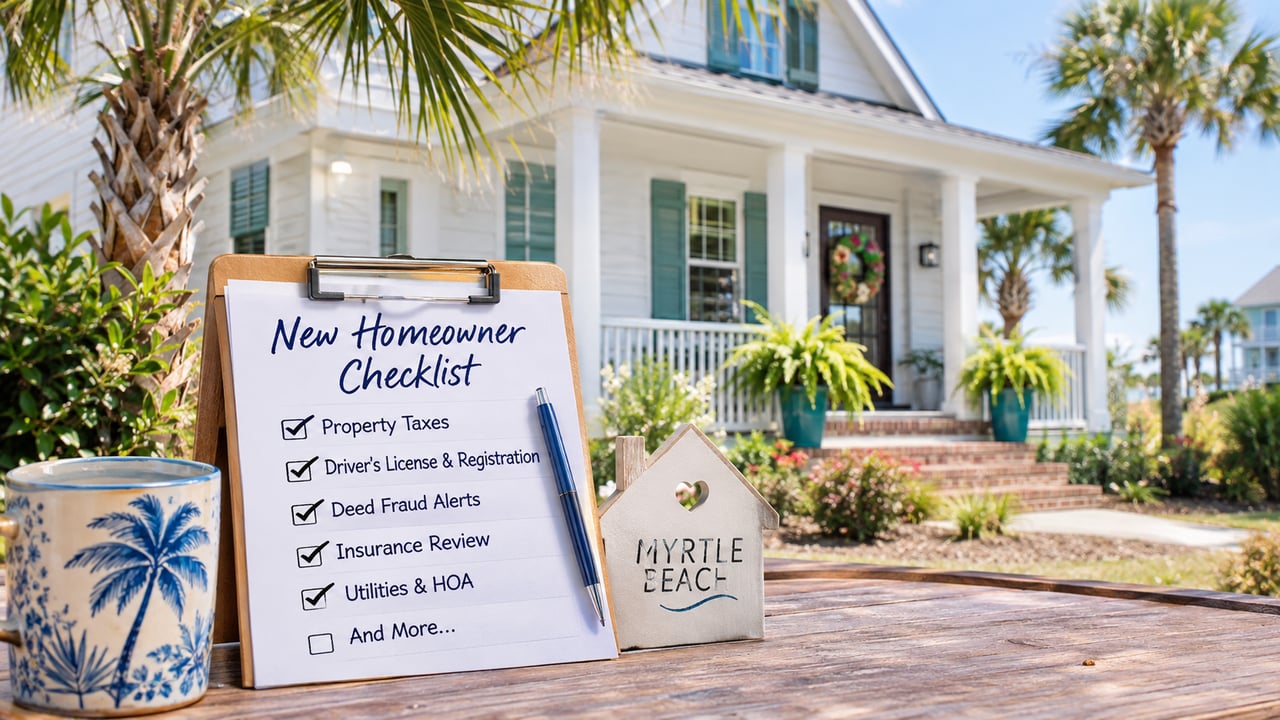
From property tax savings to paperwork most buyers overlook, here's what to take care of after getting the keys to your coastal home.
Taxes, Fees and Rules
How South Carolina's 25% ATI exemption could lower property taxes on qualifying second homes and investment properties along the Grand Strand.
Taxes, Fees and Rules
A new sales tax begins May 2027, with property tax credits planned for homeowners, second-home owners, and other property taxpayers across Georgetown County.

Taxes, Fees and Rules
How to protect your coastal property with free deed monitoring alerts in Horry and Georgetown Counties before a costly surprise catches you off guard.
From buying and selling to real estate investing, Megan Parker delivers trusted guidance, local market expertise, and personalized solutions tailored to your goals. Her client-focused approach ensures a smooth, successful experience at every stage of your real estate journey.