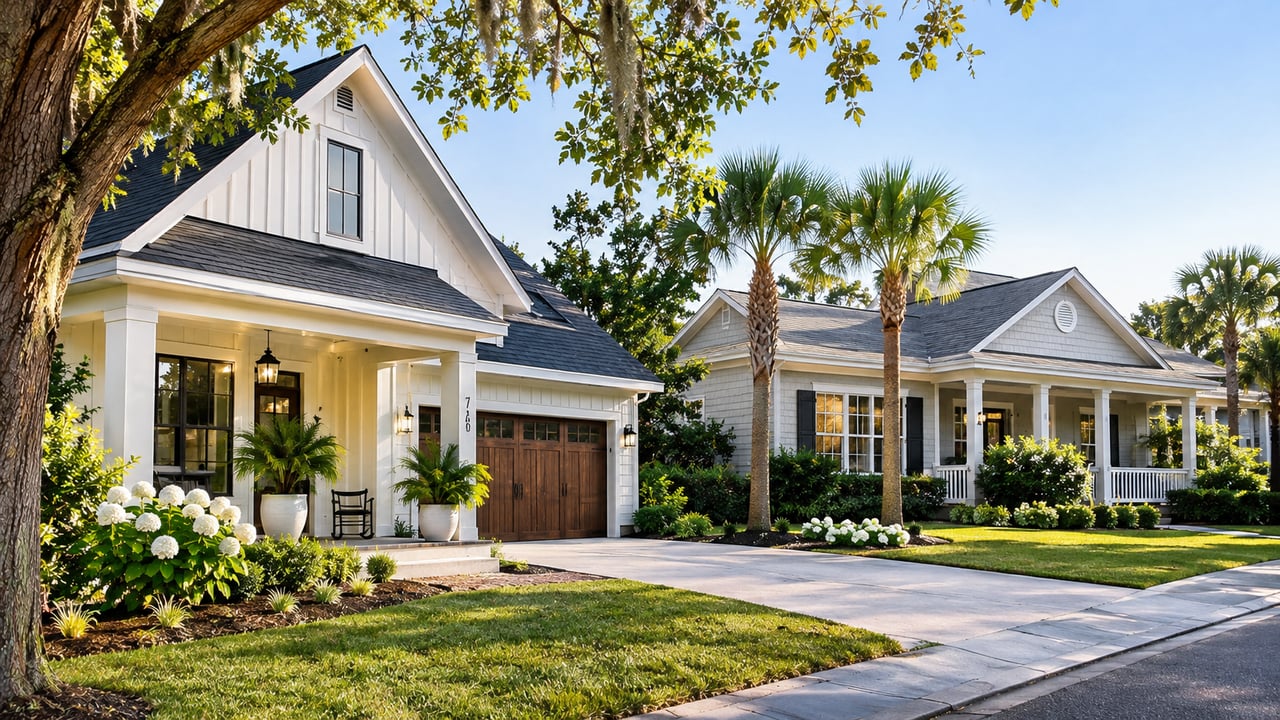
Myrtle Beach New Construction vs. Resale: Which Is Better?
November 11, 2026
November 11, 2026
There's something about walking into a brand-new model home. The kitchen is beautiful, the finishes feel current, and the builder may be advertising thousands of dollars toward closing costs or a mortgage rate you haven't seen anywhere else.
Then you tour a resale home for the same price. It has mature trees, a fenced backyard, an established neighborhood, and a screened porch overlooking a wooded preserve.
Suddenly, the decision isn't quite so obvious.
I see this often with buyers relocating to Myrtle Beach. They begin their search convinced they want new construction, only to discover an existing home with features they'd otherwise pay extra for. Sometimes the opposite happens. They fall in love with an established neighborhood but realize a new home offers the layout and maintenance expectations that fit their lifestyle better.
The question isn't simply whether new construction or resale is better. It's what you're actually getting for the money.
Here's how I help buyers compare the two throughout Myrtle Beach, Market Common, Carolina Forest, Murrells Inlet, and the surrounding Grand Strand.
One of the first things I explain to buyers touring new construction is that the model home is essentially the builder's showroom.
That oversized kitchen island, beautiful trim work, upgraded flooring, screened porch, and outdoor living space may not be included in the advertised price.
Builders typically offer a base home with standard specifications. Depending on the community and construction stage, buyers may also pay for:
Some of these features may already be included in a completed inventory home. Others might require additional selections and payments.
A resale home may already have thousands of dollars in improvements that the current owner completed over the years.
For example, consider a new home priced at $425,000 and an existing home listed for $445,000.
The new home initially appears less expensive. But once a buyer adds a $12,000 lot premium, $8,000 in structural options, and $10,000 in desired upgrades, that new construction price becomes $455,000.
And that may be before adding fencing, window treatments, or landscaping improvements after closing.
Those numbers are illustrative, but the scenario is familiar.
It's why I prefer comparing finished homes rather than advertised starting prices.
Myrtle Beach builders may offer closing cost contributions, mortgage rate buydowns, design center allowances, or pricing incentives on selected inventory.
These offers can be particularly attractive to buyers who want to preserve cash at closing.
But the headline incentive isn't always the final benefit.
Some builder promotions require buyers to use a preferred lender or affiliated closing service. Others apply only to particular homes, contracts signed within a specified period, or transactions closing before a deadline.
A builder advertising $15,000 toward closing costs may be offering a meaningful benefit. Still, I want buyers to understand the financing terms attached to it.
Compare the full loan estimates, including interest rates, lender fees, discount points, cash required at closing, and the payment after any temporary buydown expires.
A temporary mortgage rate buydown isn't the same as a permanently reduced interest rate.
And an incentive tied to an aggressive closing deadline may be less attractive if the buyer has a home to sell or a relocation schedule that doesn't align.
Builders can sometimes be more flexible on incentives, upgrades, or selected inventory than on the advertised base price. Negotiability depends on the builder, community, and property.
The important thing is understanding the complete offer rather than getting distracted by the largest advertised number.
An established home has had time to become a home.
The trees have grown. The landscaping is established. Someone may have already fenced the yard, installed irrigation, extended the patio, or added custom storage in the garage.
Those improvements can make a considerable difference when comparing ownership costs.
In established sections of Market Common, Surfside Beach, or Murrells Inlet, buyers may also find neighborhoods with completed amenities and a clearer sense of the surrounding development.
You're often able to see what the street looks like on a typical afternoon, how close neighboring homes sit, and whether the backyard offers the privacy you're looking for.
With new construction, some of those things may still be taking shape.
A beautiful wooded view behind a new homesite can be appealing, but I'd want to know whether that land is protected conservation property or simply an undeveloped parcel.
That's an important difference.
Existing homes aren't automatically less expensive, however. An older roof, HVAC system, water heater, or other major component may introduce costs that need to be considered.
The value of a resale home depends on its condition and the usefulness of the improvements already in place.
This is one of the biggest considerations I discuss with buyers.
You can change paint colors, replace countertops, or renovate a bathroom. Changing the location of your home within a neighborhood is a different story.
When comparing homesites, pay attention to the orientation of the property, adjacent roads, drainage, utility easements, and what's planned around it.
A cul-de-sac lot may offer a different experience from one facing a busy community entrance. A backyard with afternoon shade may be more desirable to some buyers than one receiving direct sunlight throughout the hottest part of the day.
I also like to consider the placement of neighboring windows and patios.
A home may have a wonderful interior layout but offer very little privacy outdoors.
Buyers touring new construction communities in Carolina Forest, Sayebrook, or Prince Creek should review available site plans and ask what may be developed around the property.
For resale buyers, there's often the advantage of seeing the surrounding homes and landscaping as they exist today.
Neither situation is automatically preferable. The point is to understand what the homesite offers beyond its lot number.
A brand-new home has never been lived in, but that doesn't guarantee every component has been installed correctly.
Construction involves numerous contractors and trades. Even conscientious builders can have items that need attention before closing.
Depending on the construction stage and the builder's policies, buyers may want to arrange independent inspections before drywall installation, near completion, and before applicable warranty periods expire.
A pre-drywall inspection can be particularly useful because certain framing, plumbing, electrical, and mechanical components are still visible.
For completed homes, an independent home inspection can identify concerns or incomplete items that deserve further review.
Builder warranties are another important consideration.
Some builders provide coverage for workmanship, systems, and structural components over different periods. The details vary, and buyers should understand what's covered, what is excluded, how claims must be submitted, and whether the warranty is transferable.
South Carolina also publishes Residential Construction Standards that provide guidance on certain construction-related complaints and performance expectations.
Those standards don't replace the actual builder warranty.
A resale home deserves equally careful inspection, with particular attention to roof condition, HVAC age, plumbing, electrical systems, moisture intrusion, and maintenance history.
In either case, the goal is to understand the property before closing rather than discover preventable surprises afterward.
A completed resale home often provides a more straightforward closing timeline once the contract, financing, and inspections are in place.
With a home that is still under construction, the expected completion date may be months away.
Weather, inspections, material availability, subcontractor scheduling, and other factors can affect progress.
This matters particularly for buyers relocating to Myrtle Beach from another state.
A family coordinating the sale of their current home, a moving company, and temporary housing may need more certainty than a proposed construction schedule can provide.
Builder contracts can contain provisions addressing construction delays, completion estimates, and circumstances beyond the builder's control.
Read those provisions carefully and have a South Carolina real estate attorney explain anything you don't understand before signing.
For buyers who need a new home without a lengthy wait, completed or nearly completed builder inventory can be worth exploring.
It may offer some of the advantages of new construction with fewer decisions left to make and a clearer anticipated closing schedule.
Many new construction neighborhoods along the Grand Strand include planned amenities such as pools, clubhouses, walking trails, pickleball courts, and fitness centers.
Those features can be attractive, but their availability and operating expenses deserve attention.
When touring a developing neighborhood, ask which amenities are completed, which remain planned, and whether the HOA has transitioned from developer control to the homeowners.
Also ask how the association is funded and whether its current budget reflects the projected cost of operating completed amenities.
Resale communities may offer more established budgets and a longer history of maintenance expenses, although that doesn't mean fees or special assessments can't increase.
A community with a lower monthly HOA fee isn't necessarily the less expensive option.
One association might include lawn maintenance, irrigation, cable, or exterior upkeep. Another may cover little beyond common-area maintenance.
Review the actual governing documents and budgets rather than comparing HOA fees in isolation.
For buyers interested in vacation rentals, confirm the community's rental restrictions and applicable local regulations before purchasing.
Two homes priced identically may have different ongoing ownership expenses.
New construction may offer newer roofing, mechanical systems, and building materials that influence insurance underwriting. Older homes can also have favorable characteristics, particularly when improvements are well documented.
Along the South Carolina coast, wind coverage, hurricane deductibles, flood exposure, and a home's intended use all deserve attention.
I recommend obtaining property-specific insurance quotes rather than relying on a general estimate or the current owner's premium.
For more information, see my guide to what affects flood insurance costs on the coast.
Property taxes are another consideration.
South Carolina generally assesses qualifying primary residences at 4%, while second homes and investment properties are typically assessed at 6%.
The current tax bill on a resale listing may reflect the previous owner's assessment history or classification. A new construction property's tax history may reflect the lot before the home was completed.
Neither figure should automatically be treated as the buyer's future tax obligation.
The Horry County Property Tax Estimator and Georgetown County Property Tax Calculator are helpful starting points for evaluating potential taxes.
This is an important question, particularly for people who begin their search by visiting model homes.
The on-site sales representative is there to sell the builder's homes. If that representative is acting as the builder's agent, their agency duties are owed to the builder.
That doesn't mean the representative can't provide helpful information. It means buyers should understand who is representing whom.
South Carolina's Real Estate Commission has specifically clarified that builder agents must comply with the state's real estate licensing and agency requirements.
You can review the South Carolina Real Estate Commission's guidance on builder agents.
Many builders also have policies governing how and when a buyer's agent must be registered, so it's worth discussing representation before your first model home visit.
A buyer's agent can help compare communities, evaluate incentives, research comparable sales, review contract terms with the closing attorney, and coordinate important inspections and deadlines.
Buyer representation and compensation terms should always be discussed and agreed upon in writing.
And if you're exploring both new construction and resale homes, working with someone who understands both sides of the market makes the comparison much more useful.
Consideration | New construction | Resale |
|---|---|---|
Purchase price | Base price may exclude options and lot premiums | Improvements may already be included |
Incentives | Builder promotions may be available | Terms negotiated with the seller |
Timeline | Depends on construction stage | Often shorter for completed homes |
Customization | Depends on builder and construction stage | Changes typically completed after purchase |
Landscaping | May require time and added investment | Often already established |
Inspections | Independent inspections still important | Inspections and maintenance history important |
Warranty | Builder warranties may apply | Existing warranties may be limited or transferable |
Neighborhood | Amenities and surrounding construction may be unfinished | Often easier to evaluate as it exists |
Is new construction cheaper than resale in Myrtle Beach?
Sometimes, but not necessarily. Builder incentives and completed inventory pricing can make certain new homes attractive. Resale properties may include expensive upgrades, mature landscaping, and improvements that would cost extra in new construction. Compare the finished cost of each property.
Can I negotiate with a Myrtle Beach builder?
Potentially. Negotiation opportunities vary by builder, homesite, construction stage, and inventory. Closing cost contributions, financing incentives, upgrades, and selected pricing adjustments may be negotiable.
Should I use the builder's preferred lender?
You can consider the builder's preferred lender, particularly if incentives are attached, but compare the full financing terms with other lenders. Evaluate the actual cost of the loan rather than focusing only on the advertised rate or incentive.
Do I need a home inspection on a brand-new house?
An independent inspection is strongly recommended. New construction can have defects or incomplete items, and inspection opportunities may exist at different stages of construction. Review the builder's policies and contract deadlines.
Are resale homes better for privacy?
It depends on the property. Established landscaping and completed surrounding development may make privacy easier to evaluate. New construction buyers should pay close attention to homesite placement, neighboring windows, conservation areas, and future development plans.
Do new construction homes have higher HOA fees?
Not necessarily. HOA fees depend on the amenities, services, property type, and association budget. Developing neighborhoods may also experience changing expenses as amenities are completed and the association transitions from developer control.
Should I bring my Realtor when I first visit a model home?
Yes, if you intend to have buyer representation. Builder registration requirements vary, and some may require your agent to be identified at the first visit. Discuss representation and compensation before touring.
Can I buy new construction if I need to move quickly?
Yes. Builders sometimes have completed or nearly completed inventory homes available. These can offer a shorter timeline than purchasing a homesite and waiting for a home to be built.
What if I'm still exploring and don't know which type of home I want?
That's a perfectly reasonable place to begin. Touring both new construction and established neighborhoods can help clarify your preferences for location, lot size, finishes, amenities, and maintenance. You don't need to decide between the two before starting your search.
I wouldn't make that decision based on the age of the home alone.
I've seen beautiful new construction homes with thoughtful floor plans and attractive incentives. I've also seen resale properties where the previous owners invested heavily in improvements that a new construction buyer would otherwise have to pay for separately.
Sometimes the right home is the one with the better lot. Sometimes it's the one with the more practical floor plan, a more convenient location, or fewer immediate expenses.
And occasionally, the property that looks like the better deal online isn't the better deal once everything is accounted for.
As a second-generation Myrtle Beach Realtor, I help buyers explore both new construction and established neighborhoods across the Grand Strand. I believe it's worth understanding what you're buying before making a decision based on a model home, advertised incentive, or listing price alone.
If you're comparing homes in Market Common, Carolina Forest, Sayebrook, Murrells Inlet, or Pawleys Island, I'd be happy to help you sort through the options and find the one that makes the most sense for your lifestyle and budget.
Explore more at Myrtle Beach Megan.
Information current as of November 2026. Builder prices, promotions, financing incentives, timelines, HOA terms, and availability are subject to change. Buyers should confirm specific details with the builder, lender, inspector, and closing attorney before purchasing.
Two coastal homes can have the same price tag and very different insurance costs. Here's what buyers should know before making an offer.

Taxes, Fees and Rules
Registration, insurance, and the local rules that change from one Grand Strand town to the next, checked against the statute as amended in May 2026.

Builder incentives can be tempting, but established neighborhoods have advantages of their own. Here's how to compare the real cost of both.
Market Reports
Through November 9, 10,322 single family homes sold, three more than last year, at an average price up 2.8% and four days faster.
Market Reports
Single-family homes are holding their ground while condos face a different set of challenges. What November's market data means for buyers and sellers along the Grand … Read more
Buying and Selling
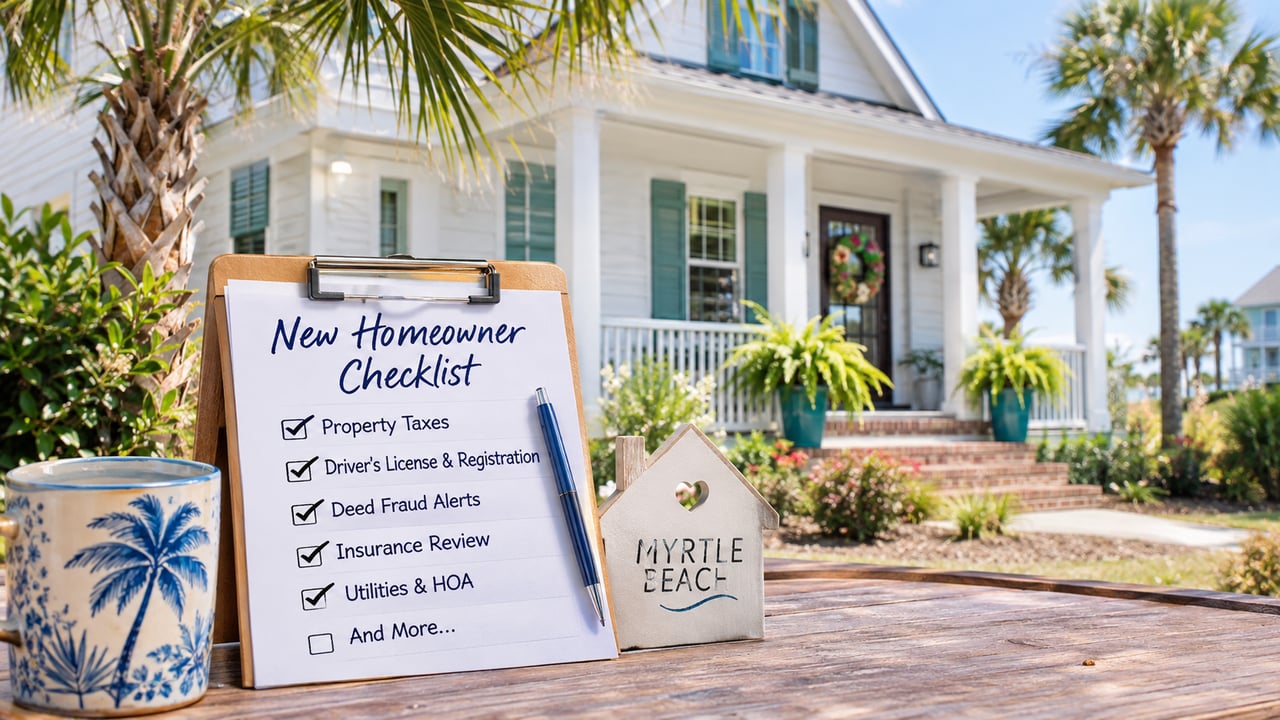
From property tax savings to paperwork most buyers overlook, here's what to take care of after getting the keys to your coastal home.
Taxes, Fees and Rules
How South Carolina's 25% ATI exemption could lower property taxes on qualifying second homes and investment properties along the Grand Strand.
Taxes, Fees and Rules
A new sales tax begins May 2027, with property tax credits planned for homeowners, second-home owners, and other property taxpayers across Georgetown County.
From buying and selling to real estate investing, Megan Parker delivers trusted guidance, local market expertise, and personalized solutions tailored to your goals. Her client-focused approach ensures a smooth, successful experience at every stage of your real estate journey.