The Two Zoning Districts That Decide Which Surfside Beach Houses Can Be Vacation Rentals
October 1, 2026
October 1, 2026
"Transient rentals, also known as a short term rentals... are permitted only in the R3 and C3 zoning districts."
That single sentence sits inside Section 17-396.10 of the Surfside Beach town code, and it does more to determine what a house is worth to an investor than square footage, distance to the beach, or anything an HOA board has ever voted on. Two houses can sit four blocks apart, built the same year, priced within a few thousand dollars of each other, and one of them can legally take a weekend guest while the other cannot take anyone for less than a month. Not because of a covenant. Because of a zoning letter attached to the parcel before either house was built.
This matters most to buyers who are running the math on a second home that pays for itself, or comes close. The Grand Strand has plenty of towns where that math starts with occupancy rates and ends with a spreadsheet. In Surfside Beach, it has to start with a zoning map.
Surfside Beach's zoning code divides the town into eleven districts. Most of them are the kind of thing nobody thinks about until they need to: C1 Highway Commercial, C2 Central Business District, C4 Entertainment District, Mobile Home Park, Planned Development, Public Land. Two districts do the heavy lifting for anyone thinking about rental income: R3 High Density Residential and C3 Amusement Commercial. Under the town's own definition, a rental is "transient" or "short term" if it runs less than a calendar month, and that use is permitted only inside those two districts. Long-term rentals, which the same ordinance permits in every residential zoning district in town, are treated as a separate category the moment a lease clears that 30-day line.
Most of Surfside Beach's housing stock sits in R1 Low Density Residential and R2 Medium Density Residential, the classic single-family blocks that give the town its name as a family beach. Those districts allow a home. They allow a long-term tenant. They do not allow a guest who books for a week. The zoning code doesn't care whether the house has a rental history, a pool, or a listing description built around "steps to the sand." If the parcel is R1 or R2, the nightly booking model is off the table regardless of what the HOA says, because the ordinance and the HOA are two separate approvals and both have to say yes.
This is the part that surprises out-of-state buyers most often. An HOA that permits short-term rentals in its own governing documents is not the same as the town permitting them. A homeowners association can only regulate what it has authority over inside its own community. It cannot override the town's zoning code, and the town's zoning code is the first gate, not the HOA's.
Here's where the math gets a second layer. Surfside Beach's own zoning ordinance draws its line at 30 days. Stay under a month, and you're in transient rental territory, restricted to R3 and C3. Stay 30 days or longer, and you're treated as a long-term lease, permitted everywhere residential use is allowed.
South Carolina's own tax treatment of rental income doesn't use the same number. The state generally treats stays under 90 days as short-term for accommodations tax purposes, with its own separate carve-outs for owners who rent a property for only a handful of days a year. That means a stay that satisfies the town's zoning definition of "long term" at 31 days can still fall inside the state's shorter-term tax bracket at the same time. An owner isn't reading one rulebook. They're reading two, written by two different governments, using two different day counts, for two different purposes.
None of this is unique to Surfside Beach as a concept. Every coastal town in the state balances zoning authority against state tax law. What's unique to Surfside Beach is how narrowly its own zoning code has drawn the line, restricting nightly and weekly rentals to a small footprint of the town rather than allowing them broadly across residential zones the way some neighboring markets do.
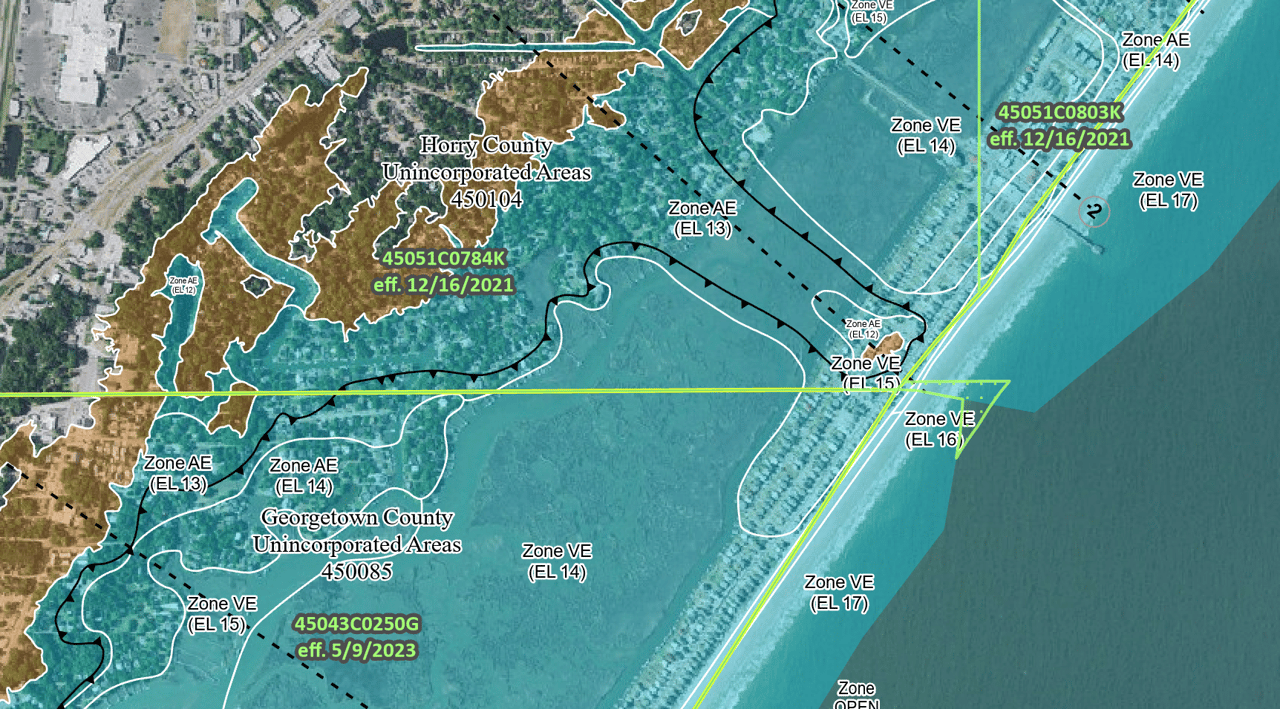
Zoning authority stops at the town line. A house on the Surfside Beach side of a street is bound by Section 17-396.10. A similar-looking house one block over, outside town limits, answers to whatever governing body has jurisdiction there instead, which may draw its own zoning lines in a completely different place. This is exactly why two houses that look interchangeable in listing photos, both close to the water, both a similar age, both marketed to the same buyer, can carry very different legal rental futures. The difference isn't the house. It's which government's zoning map the parcel falls under, and that isn't something a buyer can see from the street.
For a buyer running numbers on rental income, this changes the order of operations. The question isn't "does this house look like it could be a good Airbnb." The question is "which zoning district is this parcel actually in, and does that district permit what I'm planning to do with it." Everything else, including the HOA's rental policy, the property's rental history, and the platform fees, comes after that first answer, not before it.
A few things worth confirming before writing an offer with rental income in the plan:
Does an HOA that allows short-term rentals override Surfside Beach's zoning code? No. Town zoning and HOA covenants are two independent layers of approval. A property needs both to permit nightly rentals, not one or the other.
Can a homeowner apply to have a property rezoned into R3 to allow short-term rentals? Rezoning is a formal town process handled through the planning department and isn't something a buyer should assume will be approved before closing. It's worth a conversation with the town directly if that's part of the plan, not an assumption baked into an offer.
Is the 30-day definition the same everywhere in Horry County? No. Surfside Beach's own code sets that threshold for its own town limits. Neighboring towns and the unincorporated parts of the county set their own definitions and their own zoning maps, which is exactly why the same rental strategy can work on one side of a street and not the other.
Rental income math in Surfside Beach starts with a zoning letter, not a listing photo. If you're comparing properties here against income potential, I'd rather walk the actual parcel data with you before you write an offer than have you find out the zoning answer after you already own the house. Reach out to Megan Parker and let's look at the map together.


Events
From buying and selling to real estate investing, Megan Parker delivers trusted guidance, local market expertise, and personalized solutions tailored to your goals. Her client-focused approach ensures a smooth, successful experience at every stage of your real estate journey.